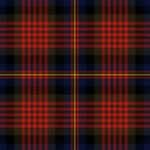
MacDougall Tartan
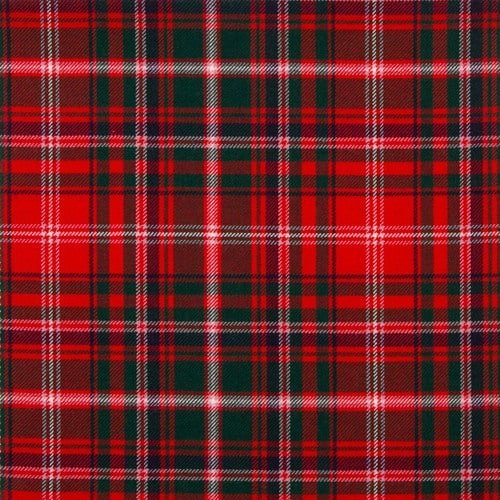 MacDougall Modern
Clan MacDougall
The MacDougalls descend from Dougall, eldest son of Somerled, the Norse-Gaelic lord who was killed at the Battle of Renfrew in 1164. Dougall’s share of his father’s sea kingdom was Lorn in Argyll together with Mull, Lismore, Jura, Tiree and Coll, and from it the family took the style of Lords of Lorn. They share an ancestor with Clan Donald, who descend from Somerled’s son Ranald.
Ewan MacDougall fought at Largs in 1263, and Norway ceded the Hebrides to Scotland three years later. The clan’s marriage into the Comyn family set it against Robert the Bruce after Bruce killed John Comyn in 1306; the MacDougalls beat him at Dalrigh that year and were defeated in turn at the Pass of Brander, losing their lands. John Gallda MacDougall recovered them in the middle of the fourteenth century. Dunollie was sacked and burnt by Covenanters under David Leslie in 1647, and the chief who came out for the Jacobites in 1715 and fought at Sheriffmuir went into exile until his pardon in 1727.
The MacDougall tartan
The Scottish Register of Tartans holds an unusually large group of MacDougall records — eleven of them, carrying dates from 1816 to 2005, among them 1819, 1831, 1842, two separate 1850 setts, 1880, 1906, 1966, 1980 and 2005. The register treats these as distinct entries rather than as recolourings of one another, which makes MacDougall one of the more tangled clan tartan histories.
The 1842 sett comes from the Vestiarium Scoticum, the book published that year by the brothers who styled themselves Sobieski Stuart and which was later shown to be a forgery; its contents list includes “Clann Dowgall of Lorne”. The Clan MacDougall Society of North America records a further pattern, called Heritage MacDougall, woven by William Wilson of Bannockburn around 1800 to 1820 from a piece of old cloth supplied by the chief, and rediscovered at Dunollie House in 2010. A second Dunollie find, called Dalriada, the society dates to the early eighteenth century and describes as most likely a district cloth rather than a clan tartan at all.
A note on honesty: Modern, Ancient, Weathered and Muted MacDougall are dye colourways of the same threadcounts, not separate tartans — the clan society itself calls Ancient “a faded version of the Modern design”. The society dates the dress sett to about 1970 while the register carries a 2000 date for MacDougall (Dress), and the two do not agree. No MacDougall sett predates the commercial era of tartan weaving. The Brooch of Lorne, traditionally said to have been torn from Bruce’s cloak at Dalrigh, is dated by Dunollie itself to the late sixteenth century on stylistic grounds.
Clan facts
| Chief | Morag MacDougall of MacDougall, 31st Chief, died 22 January 2026; the chiefship passed to her son, Robin MacDougall of MacDougall |
|---|---|
| Motto | Buaidh no Bàs — “Victory or death” |
| Plant badge | Bell heather; cypress is also recorded |
| Lands | Lorn in Argyll, with Mull, Lismore, Jura, Tiree and Coll; seat at Dunollie, Oban |